Twenty-four shaders, and the sliders to go with them
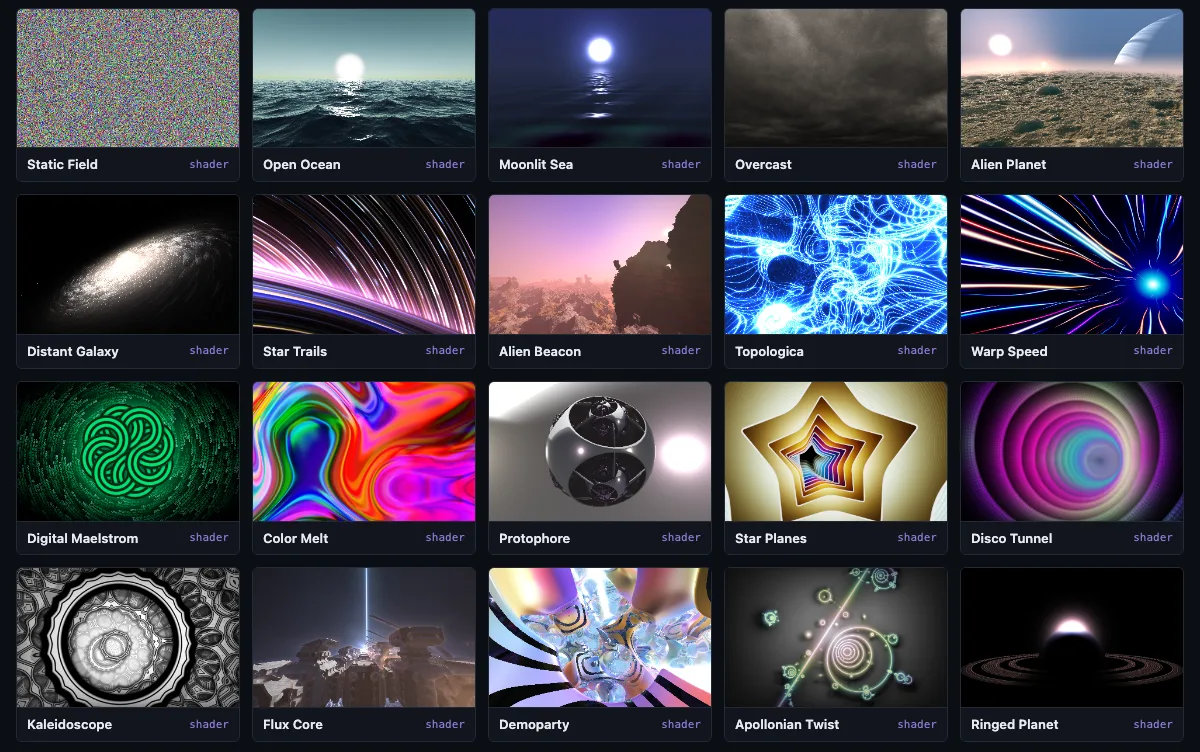
The effects gallery got a lot bigger this week. The Shader tier — single fullscreen fragment shaders that sit below the thirteen benchmark scenes — went from five scenes to twenty-four, and every one of them now has a slider or two you can drag to change what you’re looking at.
What’s new
Twenty-one new scenes. An open ocean with the sun low on the water. A moonlit sea that barely moves at all, which makes it the kindest thing here to leave running on an OLED. An overcast sky, a cratered alien planet with a ringed giant on the horizon, a pink alien canyon, a spiral galaxy tilted toward you, star trails, a warp tunnel, green code rain spiraling around a knot, a chrome fractal sphere under a studio light, a black-and-white kaleidoscope, a glass heart in a ring of live current, and a handful more.
Two older scenes, Synthwave Horizon and Neonwave Sunrise, were retired to make room.
The tiles changed too. Until now each shader tile showed a hand-painted sketch of its scene, and the sketches were not always right. Now the tile is the scene: the shader draws one frame into it the first time it comes near the screen, and hovering plays it live.
Sliders
Open any shader and the control strip has one or two sliders that weren’t there before, next to load, speed and quality.
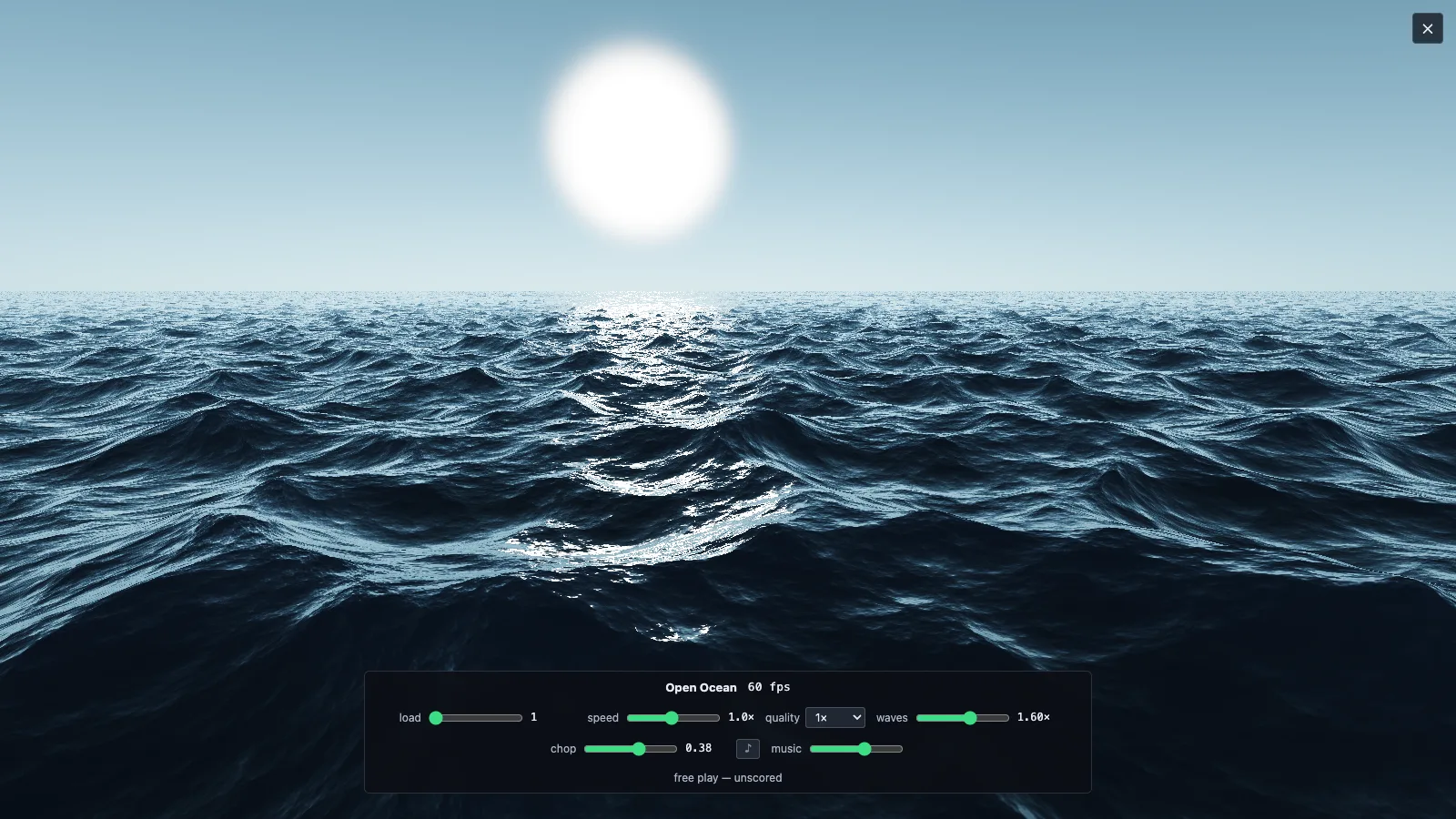
Where a scene’s author left a number that shapes the whole thing, the slider is that number. The ocean gets wave height and chop. Overcast gets cloud cover and light. The galaxy gets the twist of its arms, Star Trails the number of trails, Warp Speed the number of streaks. Color Melt gets its author’s own seed — the code’s comments invite you to change it, and any value gives you a different set of shapes. Demoparty gets its tempo in beats per minute.
Some scenes have nothing inside that can move without breaking something else. Those get hue and zoom instead, applied around the scene rather than inside it. Every slider starts where the author left it, so the first thing you see is always the scene as it was made.
Three scenes ask before they play
We put every shader through a flash test. It measures how brightness swings across patches of the screen over time, the way guidance on photosensitive epilepsy counts flashes, rather than going by how busy a scene looks. Two fail: Flux Core and Demoparty. Hypernova, the benchmark’s exploding star, was always marked as flashing, so it joins them.
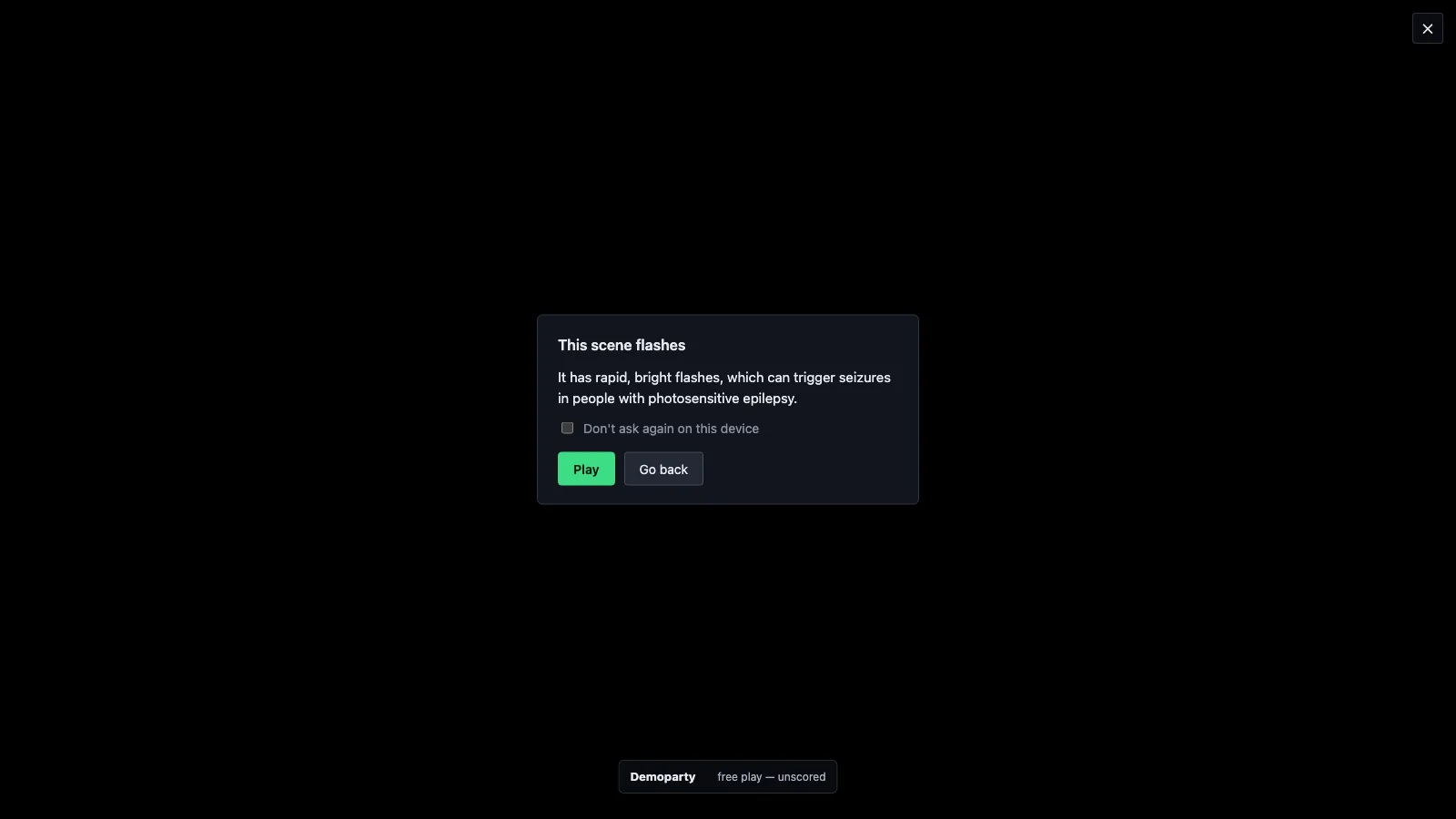
All three now ask first, and the two shaders’ tiles stay still on hover until you’ve said yes. Tick “Don’t ask again on this device” and you won’t see the question again. Back out, and nothing is remembered: you’ll just be asked next time. Every other scene opens straight away — including Static Field, which looks like the most violent thing on the page and passes easily, because its noise averages out over any patch of screen big enough to matter.
How they were picked
These shaders were written by other people, so the licence came first. Shadertoy’s default terms don’t allow commercial use, and this site carries ads, so only an explicit public-domain or MIT grant counted. Nineteen of the new scenes are public domain and two are MIT. We read each grant in the author’s own code, then checked every shader for code borrowed from somewhere else, since a free licence on a remix doesn’t free the parts that were borrowed. Several good-looking candidates didn’t make it past that check. The authors are all credited in a table on the effects page.
One scene stayed out for a different reason: a beautiful sunset ocean that managed 29 fps at 1080p on our reference Mac. On a phone it would have been a slideshow.
On a phone
The heaviest shaders open at a lower resolution on high-density screens, so they start smooth. They never drop below one device pixel per CSS pixel, and the quality control takes them back up if your hardware can keep pace — the fps readout is live, so you’ll know. None of this touches the benchmark: the shaders are never scored, and the scored workload has been frozen since version 2.2.0.